
Emergency
Water Under Your Floors? What to Do in the First 24 Hours
By Lucas Souza, Perfectum Floors
Published October 14, 2026

The short answer
In the first 24 hours, stop the water at the source, cut the power to wet rooms if it is safe, and pull up standing water fast. Then photograph everything, lift wet rugs and furniture, and start air moving. Mold can start within a day or two, so speed protects both your floor and your claim.
Water under your floors is a race against time, not a reason to panic. What you do in the first day decides whether a hardwood or LVP floor dries out and survives, or sits wet long enough to cup, delaminate and grow mold. The difference between a floor you save and a floor you replace is often just a few hours of fast, correct action.
This guide walks the first 24 hours in order, the way a flooring crew would work the problem in a Harvest or Madison home. Follow it top to bottom and you protect three things at once — your floor, your subfloor, and your insurance claim.
What should you do in the first hour?
The first hour is about safety and shutting off the source, not about the floor yet. Water and electricity together are the real hazard, so deal with that before you start mopping. A ruined floor is a repair; an electric shock is an emergency.
Work in order. Stop more water from arriving, make the area safe to stand in, then get the standing water off the floor as fast as you can. Every minute surface water sits, more of it wicks into seams, baseboards and the subfloor you cannot see.
- 1
Find and stop the source
Shut the main water valve for a plumbing leak, or the supply line to the fixture. For a roof or storm leak, contain it with buckets and tarps until the rain stops.
- 2
Cut the power if water is near outlets
If standing water has reached outlets, appliances or a panel, switch off the breaker to those rooms before you step in. When in doubt, stay out and call an electrician.
- 3
Get standing water off the floor
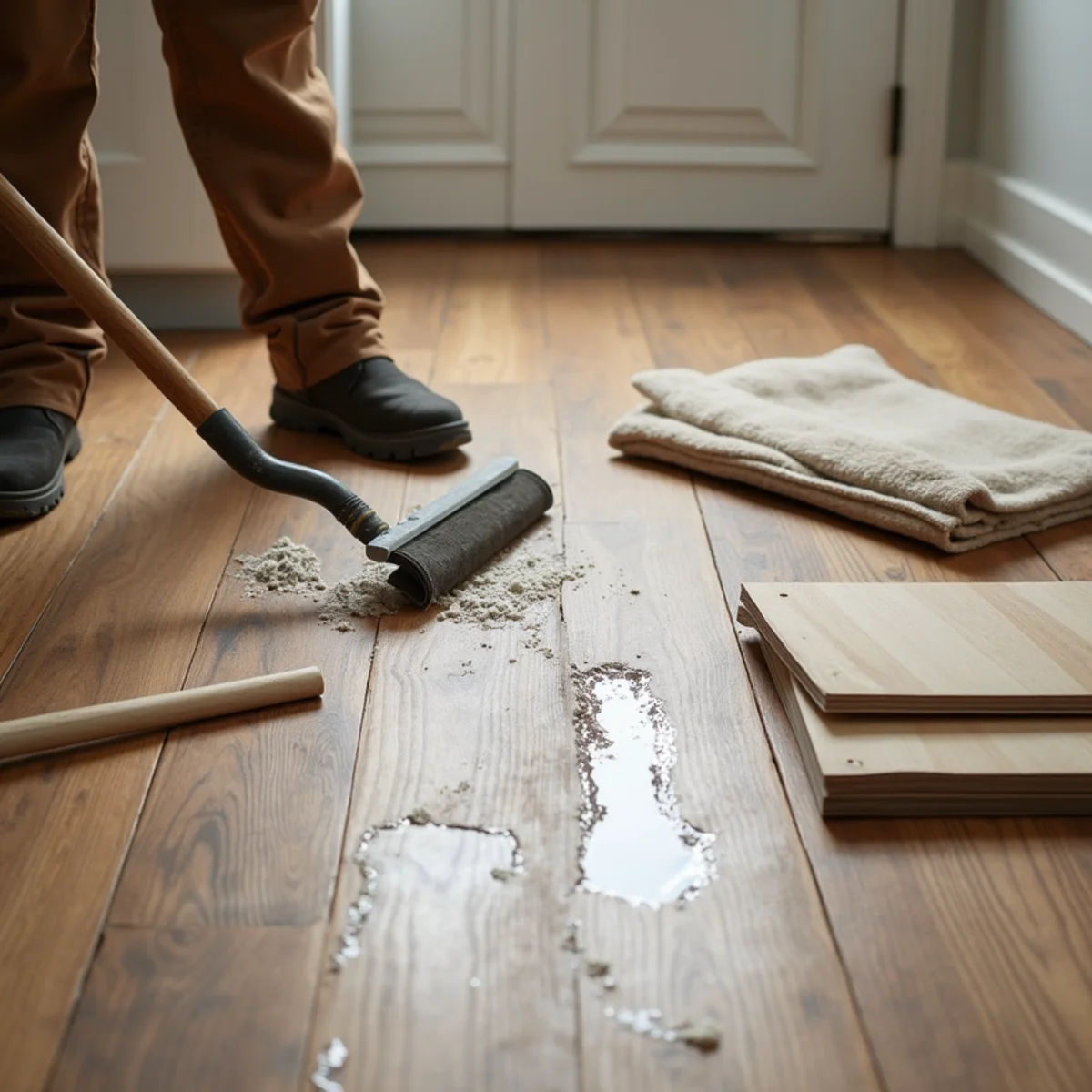
Use a wet/dry vacuum, towels and a mop. The faster surface water is gone, the less soaks into seams, subfloor and walls.
- 4
Lift what you can
Pull up area rugs, move furniture off the wet floor, and put foil or wood blocks under legs so they do not stain or wick.
- 5
Protect the rest of the house
Block doorways with towels so water does not spread into dry rooms, and get items up off any floor the water is heading toward.
Not sure how far the water spread under your floor? We find the wet subfloor you cannot see and give you a straight answer on what can dry and what needs replacing. Call (904) 533-7260.
Call (904) 533-7260
How do you dry the area fast enough to matter?
Drying is the whole game. Mold can begin to grow within 24 to 48 hours on a wet surface, so the goal is to move air and pull moisture out before it sets in. Surface-dry is not the same as dry — water hides in the subfloor, under baseboards and inside wall cavities.
Open windows only if the outdoor air is drier than the air inside, which in a humid Tennessee Valley summer it often is not. On a muggy day, opening up can add moisture instead of removing it. A dehumidifier plus fans usually beats open windows here, and running your HVAC helps condition the air.
Aim the air at the edges and seams, not just the open middle of the floor. The field of a room dries first; the places water hides — against walls, under trim, in corners — dry last and matter most.
- Run a dehumidifier in the affected room, emptied or drained continuously
- Point fans across the floor, not just at it, to keep air moving over seams
- Pull baseboards and trim so wall cavities and floor edges can breathe
- Lift a plank or a corner of flooring if you can, to vent the subfloor
- Keep the HVAC running to circulate and condition the air
- Check again at 24 and 48 hours — floors can look dry on top and stay wet beneath
Do not rush the floor back together
The most common mistake is relaying or refinishing a floor before the subfloor is truly dry. Trapped moisture cups hardwood, lifts LVP and feeds mold under a floor that looks fine on top. A moisture meter reading, not a calendar, tells you when it is safe.
What should you document for insurance?
Before you clean up the evidence, photograph it. Whether or not you file a claim, good documentation costs nothing and protects you if you do. Insurers want to see the source, the extent, and that you acted quickly to limit damage.
Shoot wide first, then close. A wide shot proves the scale; a close-up proves the cause. Do this before you start hauling things out, because once the room is cleaned up you cannot recreate what it looked like.
- Wide photos and video of each affected room before you move anything
- Close-ups of the water source — the failed pipe, appliance or ceiling stain
- The waterline on walls, cabinets and baseboards
- Receipts for fans, a dehumidifier, a plumber or any emergency work
- A written list of damaged flooring, trim and belongings with rough dates and values
- Notes on when you noticed it and what you did, in order
Keep a small sample of the damaged flooring if you can. It helps your contractor match a replacement and shows the adjuster what was there. Save it somewhere dry until the claim is settled.
Which floors can be saved and which usually cannot?
It depends on the material and how long it stayed wet. A quick cleanup gives most floors a fighting chance; a floor that sat in water for days is usually a replacement. Here is the rough outlook by material.
| Floor type | Short exposure | Long or repeated soaking |
|---|---|---|
| Solid hardwood | May dry if caught fast; expect some cupping | Usually cups or buckles; often replace |
| Engineered hardwood | Sometimes savable if dried quickly | Top layer delaminates; usually replace |
| Laminate | Edges often swell even when dried fast | Swells and crumbles; replace |
| Luxury vinyl plank (LVP) | Plank often fine; subfloor is the concern | Plank survives but trapped water rots subfloor |
| Carpet and pad | Carpet may clean; pad usually tossed | Replace pad and often the carpet |
Notice the pattern: with LVP and tile the plank or tile can survive, but the subfloor beneath it is the real question. A waterproof floor laid over a wet, rotting subfloor is a problem you cannot see until it fails.
There is also the question of what the water was. Clean water from a supply line is one thing; water from a sewer backup or a flood that ran across a yard is another. Contaminated water soaks porous flooring and pad with bacteria, and those materials usually come out regardless of how fast you dried them.
How the floor was installed matters too. A glued-down floor traps water against the subfloor and dries slowly; a floating floor can sometimes be lifted at a corner to vent and dry underneath. Nail-down hardwood sits tight to the subfloor, so moisture lingers at that contact line. Your installer’s method affects how fast — and whether — a floor recovers.
How do you know when it is actually dry?
This is the step most homeowners skip, and it is the one that decides whether the repair holds. A floor can feel dry underfoot and read wet on a meter. You cannot judge it by touch, by smell, or by how many days have passed.
A flooring pro uses a moisture meter to compare the affected wood and subfloor against a normal reading for the season. Only when the numbers match a stable baseline is it safe to put the floor back, refinish, or lay new material. Put a floor down over wet subfloor and you are scheduling a second failure.
If you can, check the same spots daily and watch the trend rather than one reading. A number that keeps dropping means the floor is drying; one that stalls high means moisture is still feeding in from somewhere you have not found. A reading that will not fall is a signal to keep hunting for the source.
The bottom line on water under your floors
The first 24 hours decide most of the outcome. Stop the water, kill the power if it is near electricity, pull up standing water, and get air and a dehumidifier working — then photograph everything before you clean up. Do not relay or refinish anything until a meter says the subfloor is dry. When you are past the emergency, a flooring crew can tell you what truly dried and what needs replacing, so you fix it once instead of twice.
FAQ
Frequently asked questions
Services
Related flooring services
Service areas